
pico Plywood Contact
Contact Information
To learn more about our Plywood Products or discuss your project requirements, please reach out to us through the following channels.
MARINE PLYWOOD
Fromager Plywood: Is It the Same as Ceiba Plywood? Discover its properties, density and common uses in furniture and carpentry.
Choosing the right marine plywood for boats affects everything from how long a hull lasts below the waterline to how a yacht interior looks after five seasons of use. This guide covers what marine plywood actually is, how it compares to standard plywood, which species and grades suit which part of a boat, and the standards and thicknesses that matter — so you can specify with confidence whether you’re building a work boat or fitting out a yacht interior.
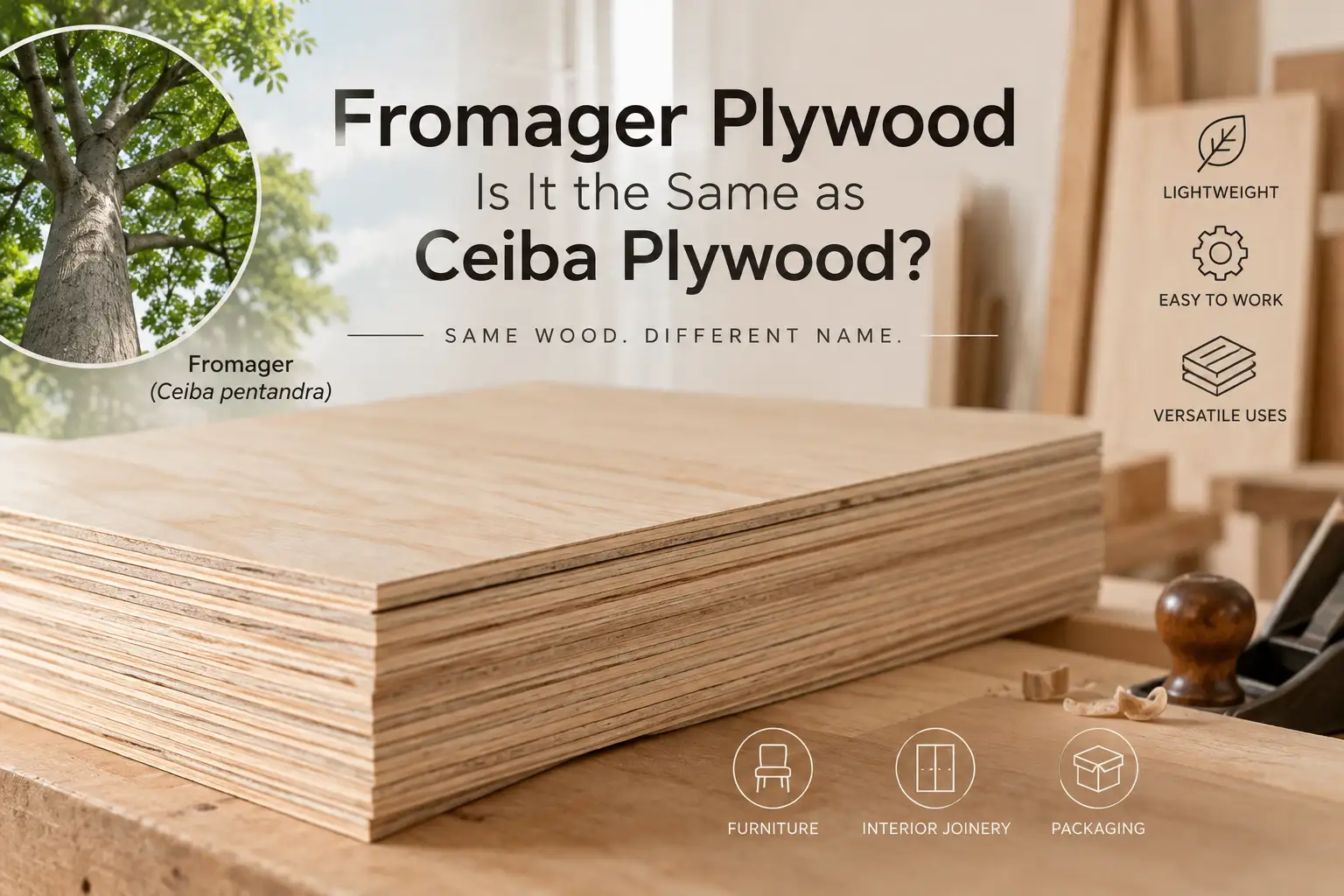
Short answer: yes. Fromager plywood is plywood made from Ceiba pentandra — the same tropical species Picó Plywood sells as Ceiba plywood. If you’ve come across the name «Fromager» while sourcing lightweight plywood, you’re looking at the same product, just under its French commercial name. This guide covers why the two names exist, the wood’s real properties (including where it’s genuinely well suited, and where it isn’t), and where to find it in our range.
Explore our full Ceiba plywood range for specifications and availability.
Fromager plywood and Ceiba plywood are the same product: plywood manufactured from Ceiba pentandra veneers. The two names aren’t a marketing distinction between different grades or qualities — they’re simply the commercial name used in different language markets for identical timber. If you’ve been quoted «Fromager» by one supplier and «Ceiba» by another, there’s no need to compare them as competing materials.
The naming comes down to language and geography rather than any difference in the wood itself. As Ceiba pentandra is documented, the tree is commonly known as «ceiba» in Spanish-speaking countries and as «fromager» in French-speaking countries — both names refer to the same species, widespread across tropical Africa, Central America, and South America. Buyers sourcing through French-speaking suppliers or markets will typically encounter «Fromager»; buyers working with Spanish-speaking or Anglophone suppliers more often see «Ceiba.»
Ceiba pentandra is one of the lightest commercial timber species used in plywood manufacturing, with a density of around 320 kg/m³. That low weight translates directly into lighter furniture and components, easier handling during fabrication and installation, and lower shipping weight — which matters as much for a workshop moving panels by hand as it does for a container going overseas.
Fromager/Ceiba is easy to cut and machine, but it’s worth being upfront about its limits rather than selling it as suited to everything. Because the wood is quite soft, it can tear out and leave a slightly woolly surface on some boring and routing operations, and nail-holding strength is modest compared to denser hardwoods. None of this rules out furniture or joinery use — it simply means fine detailing benefits from sharp tooling and, where mechanical fixings carry real load, screws or dowels are a better choice than nails alone.
The wood is pale, close to creamy-white, with a relatively straight grain and a smooth surface once sanded — a good base for painted finishes, veneers, or laminates where a light, unobtrusive substrate is wanted rather than a strongly figured hardwood look.
Rather than duplicate a full technical data sheet here, the specification questions that actually matter when sourcing this panel are: panel thickness, overall dimensions, veneer and core configuration, whether you need a standard or faced panel, and the intended application. Picó Plywood supplies this species under two ranges: our standard Ceiba plywood (both Throughout and Twin configurations), and Ceiba faced plywood for projects that need a finished decorative face. Both are documented under EN 636-2 classification — get in touch with our team for the current technical data sheet for your specification.

The properties above translate directly into a specific, useful niche rather than a universal recommendation. Low weight makes it a natural fit wherever reducing the finished weight of a piece matters — cabinetry that needs to be lifted and installed by hand, furniture destined for shipping, or lightweight structures where a denser panel would be over-engineered. Its ease of machining keeps fabrication straightforward for standard carpentry work, and the smooth, pale surface takes paint and veneer well for decorative or faced applications. Where the material asks for more care is in fine detail work prone to tear-out, and in any joint relying purely on nail-holding rather than screws or adhesive.
Lightweight furniture carcasses, wardrobe and cabinet interiors, and drawer components all benefit from Ceiba’s low weight without sacrificing workability.
The smooth, pale surface is a practical substrate for painted joinery, laminated finishes, and interior panelling where the panel itself won’t be the visible finished surface.
The species is used for mouldings and similar profiled components, where its softness makes it easy to shape and its light weight keeps the finished piece manageable.
Low density and straightforward machining also make it a practical choice for boxes, crates, and other lightweight packaging applications, where structural demands are modest but handling weight matters.

Both are genuinely lightweight species, but they suit different jobs. Okoumé is denser (around 430–450 kg/m³) and considerably stronger, which is why it’s the reference species for marine and structural boatbuilding applications. Fromager/Ceiba is lighter still and better suited to furniture and interior work rather than structural or moisture-exposed use.
Poplar sits between the two on density and offers good all-round workability and stability at a competitive cost, making it a common choice for general furniture and construction panels. Fromager/Ceiba is the lighter option of the two, worth specifying when minimizing weight is the priority rather than maximum stiffness or cost efficiency.
|
Feature |
Fromager / Ceiba |
Okoume |
Poplar |
|
Density |
~320 kg/m³ |
~430–450 kg/m³ |
Moderate |
|
Weight |
Very light |
Light |
Light-medium |
|
Workability |
Easy; soft, some tear-out |
Easy, clean finish |
Easy, stable |
|
Typical uses |
Furniture, joinery, packaging |
Marine, boatbuilding |
General furniture, packaging |
|
Furniture suitability |
Good (lightweight, non-structural) |
Excellent, incl. structural |
Good, cost-effective |
Thinner panels suit lightweight cabinetry and interior components; thicker panels are better where the panel itself needs to contribute more to a component’s rigidity.
If the project has genuine structural or moisture-exposure demands, a denser or marine-certified species is the better fit — Fromager/Ceiba’s advantage is weight, not structural load-bearing capacity.
Pick standard Ceiba plywood where the panel will be painted, laminated, or hidden from view; choose Ceiba faced plywood where a finished decorative face is needed straight off the panel.
If you’re sourcing what your supplier or market calls «Fromager plywood,» you’ll find it within Picó Plywood’s Ceiba plywood range — the same species, the same panel. We supply both standard and Ceiba faced plywood configurations for furniture, joinery, and lightweight carpentry projects. Contact our team for current specifications, thicknesses, and availability.

Yes. Both names refer to plywood made from Ceiba pentandra — «Ceiba» is the Spanish-language name and «Fromager» the French-language name for the same tree.
It’s made from veneers of Ceiba pentandra, a lightweight tropical hardwood species.
Ceiba pentandra has a density of around 320 kg/m³, making it one of the lighter species used in plywood manufacturing.
Yes — it’s among the lightest commercially available plywood species, which is its main advantage for furniture and carpentry applications.
Yes, particularly for lightweight furniture, cabinetry, and interior components, where its low weight and easy machining are an advantage. It’s less suited to structural or heavy-load applications.
Common uses include furniture and cabinetry, interior joinery, mouldings, and lightweight boxes and crates.
Okoume is denser and stronger, and is the standard choice for marine and structural boatbuilding applications. Fromager/Ceiba is lighter and better suited to furniture and interior work rather than structural or wet-environment use.
pico Plywood Contact
Contact Information
To learn more about our Plywood Products or discuss your project requirements, please reach out to us through the following channels.
Esta web utiliza cookies para que podamos ofrecerte la mejor experiencia de usuario posible. La información de las cookies se almacena en tu navegador y realiza funciones tales como reconocerte cuando vuelves a nuestra web o ayudar a nuestro equipo a comprender qué secciones de la web encuentras más interesantes y útiles.
Strictly necessary cookies must always be enabled so that we can save your cookie setting preferences.
If you deactivate this cookie we will not be able to save your preferences. This means that each time you visit this website you will have to activate or deactivate cookies again.
Esta web utiliza Google Analytics para recopilar información anónima tal como el número de visitantes del sitio, o las páginas más populares.
Dejar esta cookie activa nos permite mejorar nuestra web.
Please enable strictly necessary cookies first so we can save your preferences!