
pico Plywood Contact
Contact Information
To learn more about our Plywood Products or discuss your project requirements, please reach out to us through the following channels.
MARINE PLYWOOD
Marine plywood for boats: learn how to choose durable panels for yachts and boatbuilding, including grades, wood species, thickness and marine standards.
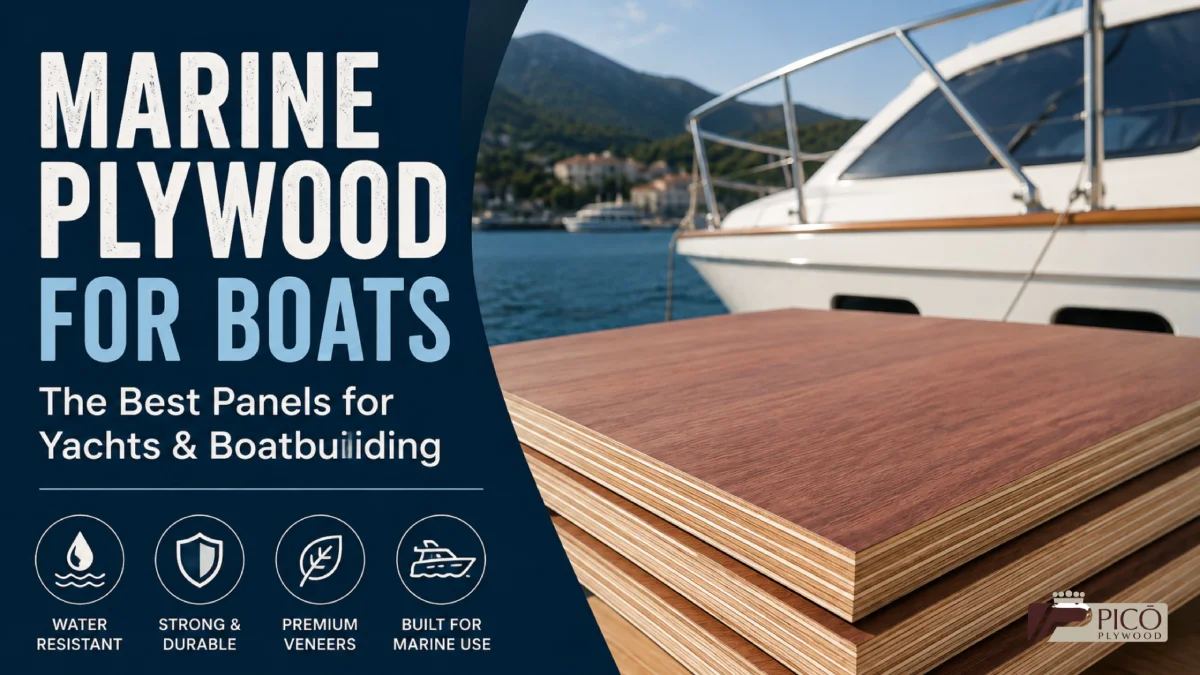
Choosing the right marine plywood for boats affects everything from how long a hull lasts below the waterline to how a yacht interior looks after five seasons of use. This guide covers what marine plywood actually is, how it compares to standard plywood, which species and grades suit which part of a boat, and the standards and thicknesses that matter — so you can specify with confidence whether you’re building a work boat or fitting out a yacht interior.
Marine plywood for boats is a specialist grade of plywood engineered for constant exposure to water, humidity and salt — bonded with waterproof adhesive, built from defect-free veneers, and manufactured to standards that regular construction plywood was never designed to meet. The gap between marine-grade and standard plywood comes down to three things: the quality of the veneer (free of voids and core gaps), the strength of the bond (fully waterproof, not just water-resistant), and the consistency of construction from sheet to sheet. In boatbuilding and yacht construction, this isn’t a cosmetic upgrade — it’s what determines whether a panel survives structural loads and constant moisture, or delaminates within a season.
See our full marine plywood range for technical specifications and available formats.
Every property below matters for a specific reason on a boat — not as a marketing checklist, but because of what actually fails when a panel isn’t up to the job.
A boat hull or bilge panel doesn’t get occasional damp — it’s in near-constant contact with water. Standard plywood absorbs moisture at the surface and through end grain, which swells the wood fibers and eventually breaks down the glue line. Marine plywood is designed around this exact failure mode; see our guide to waterproof plywood for how water resistance is engineered into a panel in the first place.
The adhesive is arguably more important than the wood itself. Marine plywood uses fully waterproof (WBP) phenolic adhesive that maintains its bond strength even after prolonged water immersion — the failure point for cheaper panels is almost always the glue line, not the veneer.
Marine-grade veneers are selected to be free of core gaps, voids and overlaps — defects that are tolerated in construction-grade plywood but become entry points for water in a marine panel. Fewer voids also means more consistent strength across the whole sheet, which matters when a panel is carrying structural load. For the underlying science of how wood interacts with moisture over time, the USDA Forest Products Laboratory publishes detailed research on wood durability and moisture performance.
Boatbuilding is one of the few construction contexts where weight is a performance variable, not just a cost one. Marine plywood is chosen partly because it delivers high strength relative to its weight — critical for hull speed, fuel efficiency, and handling, and even more critical in yacht construction where every kilogram above the waterline affects stability.
Cross-laminated construction keeps marine plywood dimensionally stable as humidity fluctuates — it won’t cup, twist or warp the way solid timber can when it moves between a damp bilge and a sun-exposed deck. That stability is what keeps fastenings tight and joints watertight over years of service.

This is one of the most common questions boatbuilders search for, and the honest answer is: regular plywood is very rarely a safe substitute, even for a tight budget.
Marine plywood uses fully waterproof phenolic adhesive throughout; regular plywood typically uses interior-grade or, at best, exterior-rated adhesive that is water-resistant rather than waterproof — a meaningful difference under constant immersion.
Regular plywood permits core gaps and patched veneer defects that marine plywood does not. Those gaps are where water gets in and delamination starts.
Marine plywood is built specifically to resist delamination under sustained wet conditions; regular plywood, even exterior-rated sheathing grade, isn’t tested or built for that duty cycle.
The combination of better adhesive and better veneer means marine plywood simply lasts longer in a wet environment – often by years, not months – which is what ultimately justifies the price difference.
In limited, fully protected, non-structural interior applications – away from bilge water, spray, or condensation – some builders do use regular plywood to control costs. It is not recommended for hulls, decks, or any component with direct or repeated water exposure.
Feature | Marine Plywood | Regular Plywood |
Marine environment | Excellent | Not recommended |
Moisture resistance | Very high | Limited |
Core quality | High | Variable |
Delamination resistance | High | Lower |
Boatbuilding | Recommended | Generally unsuitable |
Long-term durability | High | Lower |
We cover this comparison in more depth, including specific use cases, in Marine Grade Plywood vs Regular Plywood.

Okoumé is the reference species for marine plywood in boatbuilding, and it’s the species Picó Plywood produces its marine board with. It’s lightweight, offers an excellent strength-to-weight ratio, and machines cleanly with standard tools — which matters when a hull is being built stitch-and-glue or a yacht interior needs precise, repeatable joinery. Weight reduction isn’t cosmetic in marine construction: a lighter hull needs less power to move, and a lighter superstructure keeps a vessel’s center of gravity lower. See our full guide to Okoume plywood for grades, finishes and technical detail.
Beyond Okoumé, the wider marine plywood market also works with species such as Meranti, Sapele, and Douglas Fir, each with a different balance of weight, stiffness, and grain appearance. Meranti tends to be heavier and stiffer than Okoumé, which suits larger structural panels; Sapele offers a denser, more decorative grain often used in visible joinery; Douglas Fir is valued for structural strength in larger-format sheathing. Species selection is ultimately a trade-off, not a single “best” answer — which is why the comparison below matters more than any one species in isolation.
Weigh species against the specific job: weight (critical for hulls and yacht superstructure), strength (structural components vs. decorative panels), finish (visible joinery vs. hidden structure), durability (bilge and below-waterline vs. protected interior), machinability (complex curves vs. flat panels), and the intended application overall. For most boatbuilding and yacht interior projects, this balance is exactly why Okoumé remains the most widely specified marine plywood species, it performs well across all six factors rather than excelling at only one.
BS 1088 is the reference standard for marine plywood, covering veneer quality (defect-free, gap-free core), bonding requirements (fully waterproof adhesive), and construction consistency. A panel certified to BS 1088 gives a boatbuilder a documented, third-party-verified baseline — rather than relying on a supplier’s own “marine-grade” label, which has no enforced definition.
EN 636 is a separate European standard that classifies plywood by service class – dry, humid, or exterior conditions – based primarily on the gluing class. It’s a useful and complementary standard, particularly Class 3 (exterior) gluing, but it isn’t a direct equivalent to BS 1088: EN 636 says nothing about veneer defect limits the way BS 1088 does, so the two should be checked separately rather than treated as interchangeable.
Beyond performance standards, FSC-certified wood confirms the timber came from a responsibly managed forest with a documented chain of custody. For boatbuilders and yacht buyers increasingly asked about the sustainability of their materials, this is becoming as relevant a question as the plywood’s technical grade.
There’s no single thickness that’s correct for every boat — the right answer depends on span, structural load, boat design, how the panel is laminated into the surrounding structure, and any classification or design requirements the build follows. That said, thickness selection generally falls into three practical bands.
Thinner panels (roughly 4-9mm) suit interior joinery, cabinetry, and lightweight non-structural components where minimizing weight matters more than carrying load.
Mid-range thicknesses (around 9–15mm) cover the bulk of general boatbuilding applications — bulkheads, sole panels, and moderate-span structural components.
Heavier panels (18mm and above) are specified where structural load, long spans, or added rigidity are the priority, transoms, structural framing, and larger hull sections. The correct choice always comes back to the design calculation for that specific component, not a rule of thumb.

Hull panels carry the highest structural and moisture-exposure demands of any component on the boat, which is why hull-grade specification should never be compromised.
Decks combine structural load with constant weather exposure and foot traffic, a different demand profile from the hull, and one we cover in full detail separately.
Bulkheads contribute to a vessel’s overall rigidity and often double as watertight compartments, so structural certification matters even where the panel isn’t visible.
Sole panels need to handle foot traffic and occasional water underfoot without softening or delaminating over time.
Transoms carry concentrated structural load – particularly on powerboats, where engine mounting stresses the panel directly – and are typically specified at the thicker end of the range.
Interior furniture and joinery shift the priority toward finish quality and weight, while still requiring a marine-grade core for long-term stability in a humid cabin environment.
Cabinetry demands the cleanest face veneer of any application on this list, since it’s finished and viewed directly rather than painted over or hidden behind other structure.
Yacht construction shares the same underlying material requirements as general boatbuilding, but the priorities shift — which is worth calling out explicitly, since it’s rarely addressed as its own topic.
On a performance or luxury yacht, weight isn’t just a cost factor, it directly affects handling, stability, and fuel or sail efficiency. Every kilogram saved in interior fit-out or superstructure is a kilogram available for performance or payload elsewhere.
Yacht interior work – galley cabinetry, saloon panelling, sleeping quarters – calls for a lightweight, fine-grained marine plywood that takes a varnish finish well, since the panel itself is often the visible, finished surface rather than something painted over.
Not every panel on a yacht carries the same load: structural components (bulkheads, framing) still require full marine certification, while non-structural interior panels have more flexibility to prioritize weight and finish over raw strength.
Because yacht interiors are typically varnished rather than painted, face veneer quality becomes a visible specification, not just a technical one, consistent grain and minimal patching matter as much as the panel’s mechanical properties. Picó Plywood’s marine plywood solutions are produced with this dual requirement in mind.

Start with what the panel actually needs to do – hull, deck, interior – since that determines every other specification decision that follows.
Confirm BS 1088 certification for structural components, and check the gluing class (EN 636) matches the exposure conditions.
Balance strength and weight against the specific component — a hull and a cabinet door have very different priorities, as covered above.
Match thickness to load and span, not to habit, see the thickness section above for the general bands to work from.
Ask for documentation on veneer grade and core construction, particularly for any component that will be visible or load-bearing.
Factor in how the panel will be sealed and finished before ordering, it affects both the grade you need and how the edges should be prepared.
A supplier that can document standards compliance, species, and consistent batch quality is as important as the specification itself. For marine plywood for boatbuilding and yacht construction, contact our plywood specialists to discuss your project requirements.
This is a common point of confusion: waterproof adhesive between the veneer layers is not the same as the finished panel being indefinitely impermeable. Cut edges, fastener holes, and exposed end grain remain vulnerable points that need their own protection.
Any cut edge exposes the core layers directly to moisture and should be sealed before installation, not after problems appear.
Epoxy resin provides a hard, fully sealed barrier and is a common choice for hulls and below-waterline components where maximum protection is needed.
Marine-grade paints and varnishes protect the face veneer from UV and surface abrasion, and are typically applied over – not instead of – proper edge sealing.
Every fastener hole is a potential moisture entry point and should be sealed individually, particularly below the waterline. For a full walk-through of sealing and protection methods, see our guide on how to protect plywood outdoors.
There’s no honest universal figure here, service life in a marine application depends heavily on water exposure, correct installation, edge sealing, ventilation, protective coatings, ongoing maintenance, and the quality of the original panel. A well-sealed, well-maintained marine plywood component in a properly ventilated area can outlast the rest of the boat’s structure; a poorly sealed panel in constant wet contact can fail within a few seasons regardless of grade. The panel is only one variable in a longer chain.
Picó Plywood produces BS 1088-certified marine plywood built for the structural and moisture-resistance demands of professional boatbuilding.
The same Okoumé marine plywood range suits yacht interior joinery and cabinetry, where weight and face-veneer finish are as important as structural certification.
Panels are available across the thickness range boatbuilders need, from lightweight interior components to structural applications.
Picó Plywood supplies boatbuilders and yacht projects internationally. For marine plywood for boats and yachts, contact Picó Plywood to discuss your specification and request a technical data sheet.
For most boatbuilding and yacht interior applications, BS 1088-certified Okoumé marine plywood offers the best balance of weight, strength, and workability — though the right choice always depends on the specific component and its structural or aesthetic requirements.
The adhesive bond is fully waterproof, but the panel as a whole still needs sealed edges and an appropriate coating to stay protected long-term, the wood itself isn’t impermeable.
It depends on the component: thinner panels (4–9mm) suit interior joinery, mid-range thicknesses (9–15mm) cover general boatbuilding, and 18mm-plus is used for structural applications like transoms and framing.
Yes, its light weight, strong strength-to-weight ratio, and ease of machining make it the most widely specified species for both boatbuilding and yacht interior work.
BS 1088 is the reference standard for marine plywood, setting requirements for veneer quality, core construction, and fully waterproof bonding, giving a documented, verifiable baseline rather than an unregulated «marine-grade» label.
Only in limited, fully protected, non-structural areas away from water exposure. It is not recommended for hulls, decks, or any component with direct or repeated contact with water.
Yes, cut edges, fastener holes, and exposed end grain need sealing even on certified marine plywood, since the waterproof bond between veneer layers doesn’t protect these exposed points on its own.
The same marine-grade Okoumé plywood used in boatbuilding generally, but specified toward lighter panels with premium face veneers for interior joinery, and full structural grade for bulkheads and framing.
pico Plywood Contact
Contact Information
To learn more about our Plywood Products or discuss your project requirements, please reach out to us through the following channels.
Esta web utiliza cookies para que podamos ofrecerte la mejor experiencia de usuario posible. La información de las cookies se almacena en tu navegador y realiza funciones tales como reconocerte cuando vuelves a nuestra web o ayudar a nuestro equipo a comprender qué secciones de la web encuentras más interesantes y útiles.
Strictly necessary cookies must always be enabled so that we can save your cookie setting preferences.
If you deactivate this cookie we will not be able to save your preferences. This means that each time you visit this website you will have to activate or deactivate cookies again.
Esta web utiliza Google Analytics para recopilar información anónima tal como el número de visitantes del sitio, o las páginas más populares.
Dejar esta cookie activa nos permite mejorar nuestra web.
Please enable strictly necessary cookies first so we can save your preferences!